

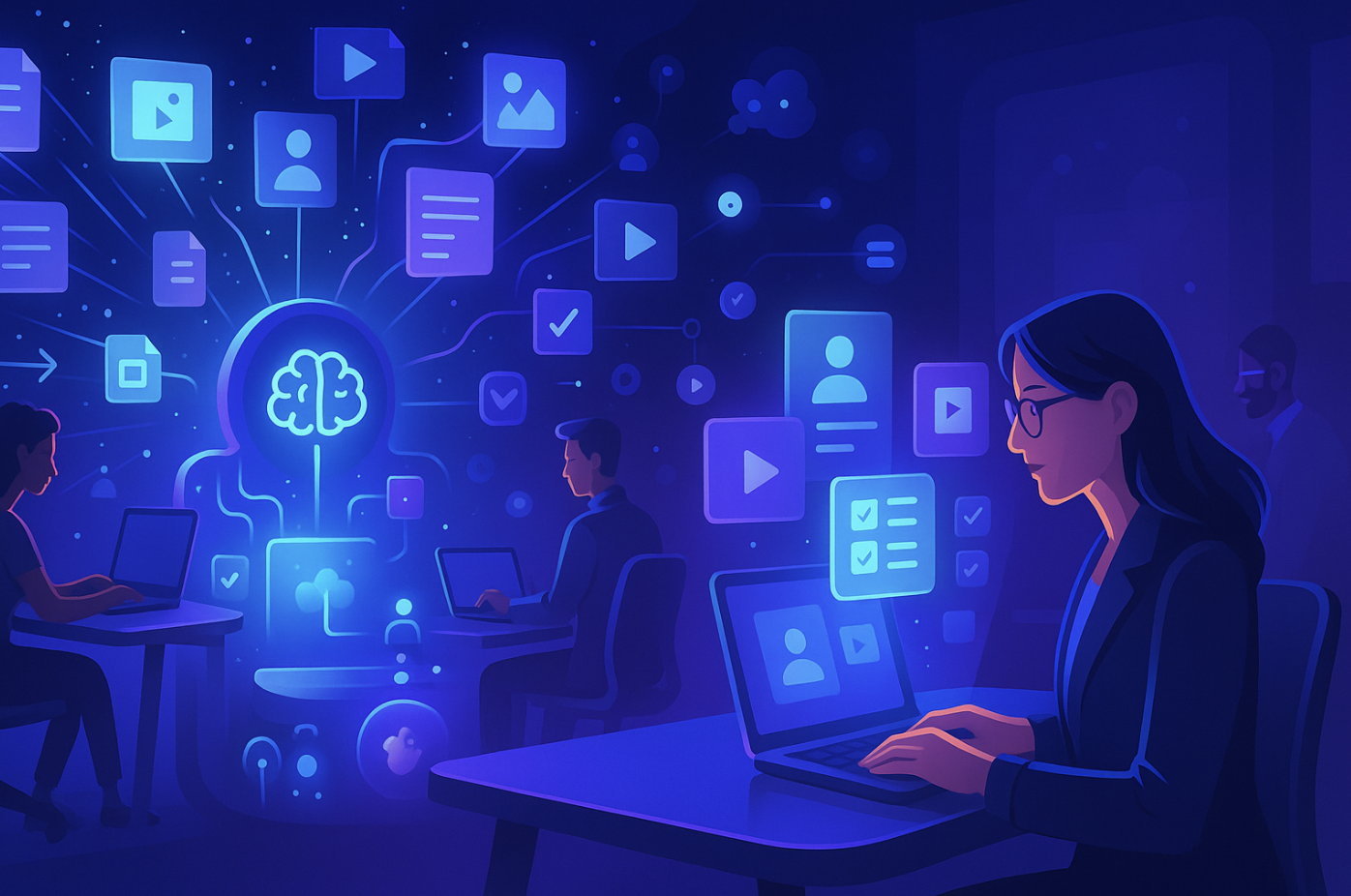
AI-Powered Content Creation: Revolutionizing Learning Development at Speed
Creating learning content has traditionally been slow, expensive, and difficult to maintain. AI is changing that by accelerating development, reducing costs, and enabling personalization at scale.
The Content Creation Bottleneck
For years, L&D teams have faced the same challenges:
- Long production cycles that delay delivery
- Limited budgets for high-quality multimedia assets
- Content that quickly becomes outdated
- Pressure to deliver more with fewer resources
How AI Accelerates Content Development
1. Automated Drafting
AI can generate lesson outlines, learning objectives, assessments, and job aids in seconds. This eliminates the blank page problem and allows instructional designers to focus on refining content instead of starting from scratch.
2. Multimedia Creation
AI tools can produce voiceovers, videos, avatars, and illustrations at a fraction of the traditional cost. This makes it possible to create engaging, multimedia-rich learning without heavy investment.
3. Translation and Localization
AI enables instant translation of content into multiple languages while adapting tone and examples for local relevance. Global teams can access the same training in their preferred language.
4. Fast Content Updates
Instead of rebuilding entire modules, AI can refresh outdated sections, swap old examples for new ones, and suggest updated case studies. This keeps content aligned with current realities.
5. Personalization at Scale
AI adapts the same core content for different roles, industries, or skill levels. Each learner experiences material that feels tailored to their needs, without multiplying development effort.
Benefits for Organizations
When applied effectively, AI-powered content creation brings clear advantages:
- Speed: Weeks of work reduced to hours
- Cost savings: Less reliance on external vendors
- Relevance: Content stays current and aligned to business needs
- Engagement: Richer, more interactive formats keep learners involved
- Scalability: Large, distributed workforces receive personalized training at the same time
Challenges to Manage
While powerful, AI is not a plug-and-play solution. L&D leaders need to consider:
- Accuracy: Outputs should be validated by subject matter experts
- Tone: Raw AI drafts can feel generic without human editing
- Bias: Algorithms can unintentionally generate biased examples
- Oversight: AI should support creators, not replace them entirely
Best Practices for L&D Teams
- Treat AI outputs as first drafts, not final deliverables
- Combine AI-generated material with human creativity and storytelling
- Put review processes in place to ensure quality and accuracy
- Build a library of prompts for consistent results
- Gather learner feedback and refine workflows continuously
Conclusion: Faster, Smarter Content Creation
AI is not replacing instructional designers. It is amplifying their impact. By automating repetitive work, AI frees up time for strategy, creativity, and innovation.
The future of L&D content is not only faster to create but also more relevant, engaging, and scalable than ever before.
Frequently asked questions
How does AI-generated content compare to human-created learning materials in terms of quality?
AI-generated content serves as an excellent foundation and can produce high-quality first drafts quickly, but it typically requires human review and refinement for optimal results. The best approach combines AI's speed and consistency with human creativity, subject matter expertise, and understanding of learner needs to create truly engaging and effective learning materials.
What types of multimedia content can AI create for learning programs?
AI can generate a wide range of multimedia content including synthetic voiceovers in multiple languages, animated avatars for video presentations, custom illustrations and infographics, interactive simulations, automated video editing and assembly, generated music and sound effects, and even basic 3D models and virtual environments for immersive learning experiences.
How can organizations ensure AI-generated learning content remains accurate and unbiased?
Organizations should implement review processes with subject matter experts, use diverse training datasets when customizing AI models, establish content quality standards and checklists, regularly audit AI outputs for accuracy and bias, maintain human oversight throughout the creation process, and gather learner feedback to identify potential issues with generated content.
What cost savings can organizations expect from implementing AI content creation tools?
Organizations typically see 60-80% reduction in content development time, 40-60% decrease in external vendor costs for multimedia production, significant savings on translation and localization expenses, reduced costs for content updates and maintenance, and lower overall cost-per-learner for personalized training materials, though exact savings vary by organization size and content complexity.
How does AI handle content personalization for different roles and skill levels?
AI personalizes content by analyzing learner profiles, job roles, and skill assessments to adjust language complexity, select relevant examples and case studies, modify learning objectives and assessments, customize multimedia elements and scenarios, adapt content depth and technical detail, and sequence information based on individual learning paths and preferences.
What are the essential skills L&D teams need to effectively use AI content creation tools?
Essential skills include prompt engineering to effectively communicate with AI systems, content curation and editing to refine AI outputs, basic understanding of AI capabilities and limitations, project management for hybrid human-AI workflows, quality assurance and review processes, and ongoing learning about new AI tools and techniques as the technology evolves.