Key Takeaways
- Workforce intelligence connects what your people can do, what your procedures say, and how your lines perform. That lets you see which skill gaps are costing you output, quality, or safety.
- Manufacturers need it now. As many as 1.9 million US manufacturing jobs could go unfilled by 2033, according to Deloitte and The Manufacturing Institute, and experienced operators are retiring with knowledge nobody wrote down.
- Completion isn't competence. Workforce intelligence measures capability in levels (read, assessed, observed) by line, site, and machine, instead of counting finished courses.
- AI makes workforce intelligence fast. It only becomes trustworthy when every insight and training sentence traces to an approved source and a qualified person signs off.
- The best way to start is small. Pick one or two critical lines, agree on success measures up front, and compare results against a baseline.
Automation is reshaping manufacturing, but one thing still decides whether a line runs well: what your people know how to do.
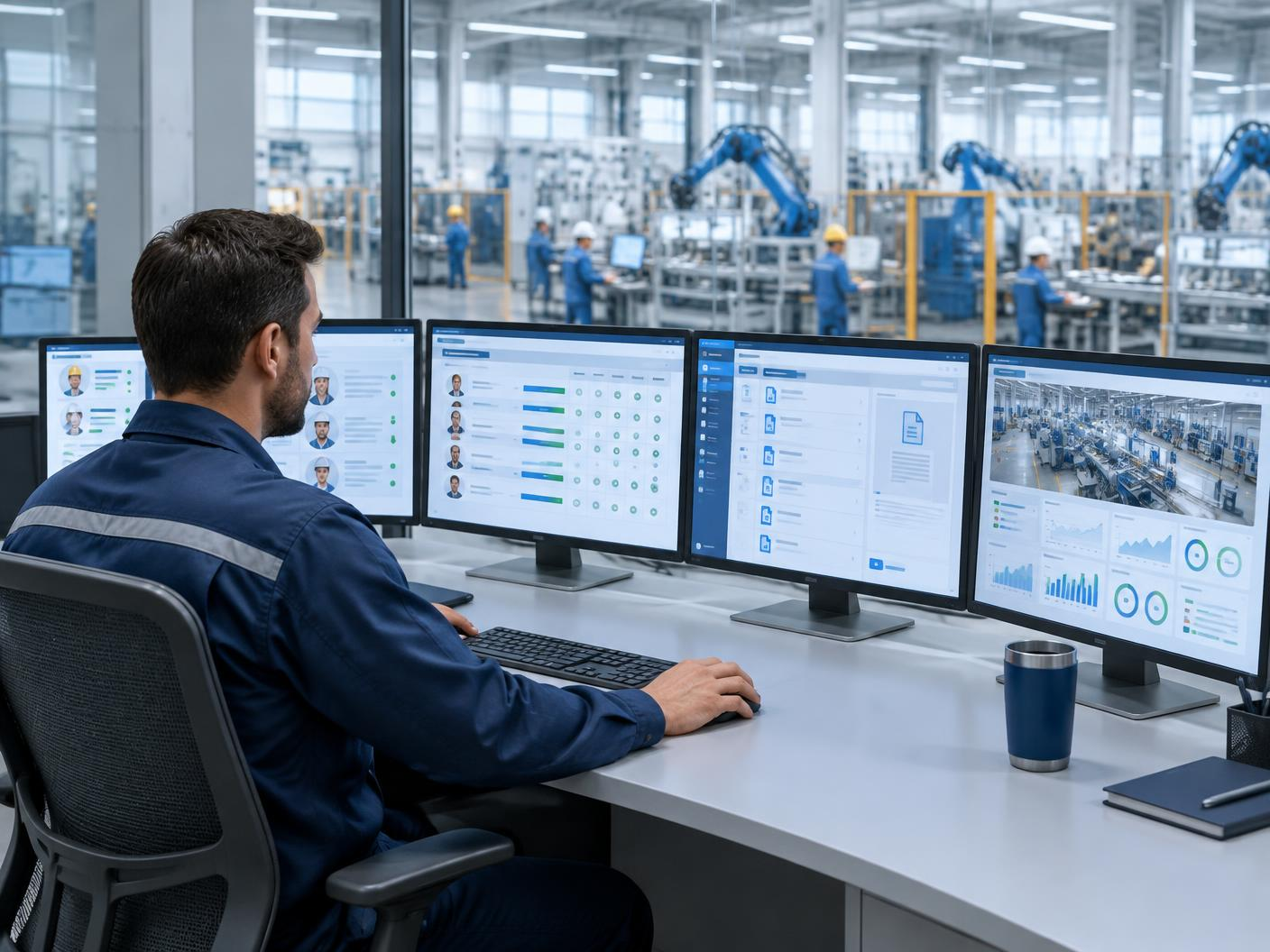
Workforce intelligence is the practice of connecting your people's skills, your approved procedures, and your plant's operating data. It shows you who can do which job, on which machine, and where a gap in skills or knowledge is costing you output, quality, or safety.
That visibility matters more every year. US manufacturers could need as many as 3.8 million new employees between 2024 and 2033, and up to 1.9 million of those jobs could go unfilled, according to Deloitte and The Manufacturing Institute.
Workforce intelligence still sounds like an HR dashboard. On the plant floor, it's something else.
So, What Exactly Is Workforce Intelligence?
Workforce intelligence connects three things most plants already have but rarely link: data about people, the knowledge in your procedures, and the performance of your lines. It shows where a skill gap is hurting production, and what it will take to close it.
You may also see the term used for people analytics or talent intelligence. Those are HR tools for planning hiring, roles, and careers. In manufacturing, the focus moves to the line.
The question isn't "who should we hire?" It's "who can run this changeover safely on night shift, and how do we know?"
At Edplay, we put the problem this way: every time an experienced operator walks out of a plant for the last time, the company loses knowledge it never wrote down. Workforce intelligence is how you see that loss coming and stop it.
I'll go into what makes good capability evidence later in this article. For now, the key thing to know is that workforce intelligence turns scattered plant data into one clear picture of who can do what.
The Three Signals Behind Workforce Intelligence
Workforce intelligence pulls from three kinds of data. Here's how each one looks on a hypothetical packaging line.
People and competency tell you who should be able to do what. This comes from HR records, role profiles, competency ratings, certifications, and assessment results.
Example: your skills matrix says three operators are qualified on Line 4's filler.
Process knowledge tells you what good work looks like. This lives in SOPs, work instructions, quality documents, manuals, existing videos, and the know-how in experienced operators' heads.
Example: the filler SOP was last revised before a new nozzle was fitted.
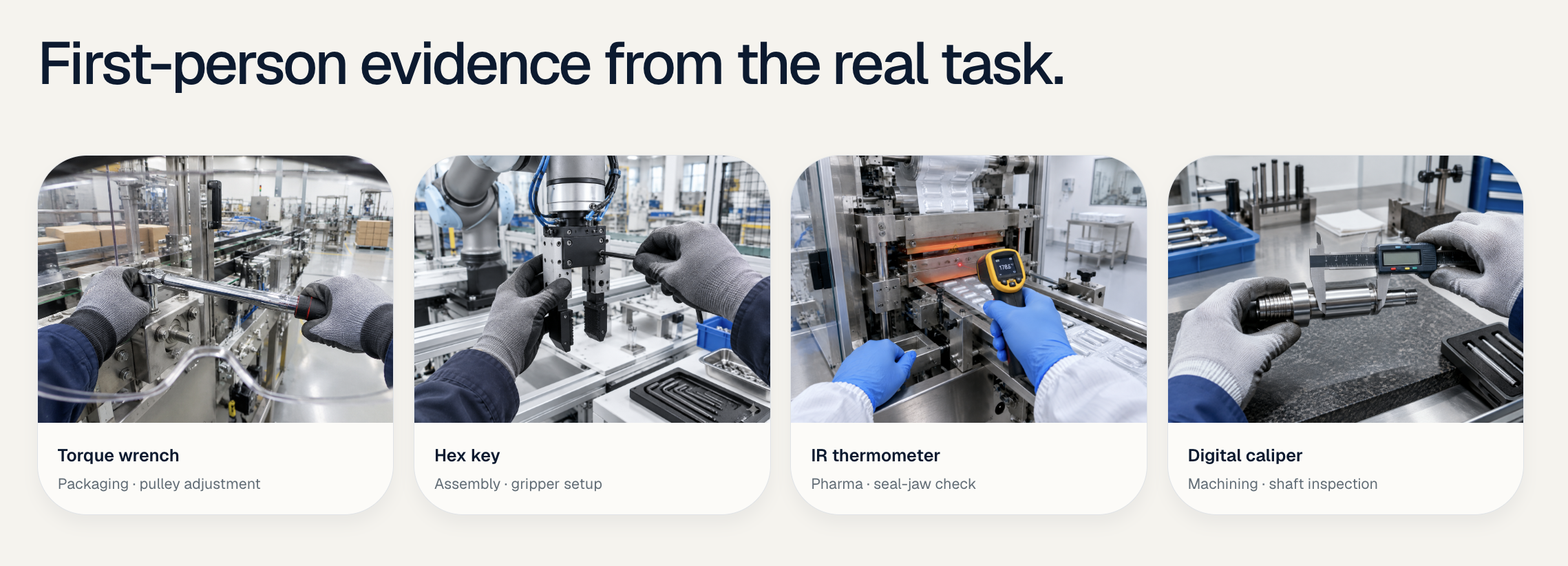
Operational signals tell you where performance is falling short. These include downtime, scrap, recurring faults, and quality and safety events.
Example: scrap on Line 4 spikes on the shift where none of those three operators is working.
Each signal tells part of the story. HR data shows certificates, not capability. Operations data shows the defect, not the cause.
A useful workforce intelligence setup uses all three. That's how you get from "scrap is up" to "we have one qualified operator per shift and an outdated SOP."
Why Is Workforce Intelligence Important for Manufacturing?
Even as plants automate, people still set up the machines, run the changeovers, and fix the faults. Their skills decide your output, quality, and safety.
The problem is that many of those skills are about to walk out the door. About one in four manufacturing workers is 55 or older, according to Bureau of Labor Statistics data.
When they leave, they take knowledge that was never written down. And there aren't enough new people to replace them, given the skills and applicant gap Deloitte and The Manufacturing Institute project through 2033.
Here's what that looks like on the floor:
- A veteran operator retires. Within months, scrap on their line climbs, and nobody knows exactly what they did differently.
- A recurring fault stops the line on night shift because the one technician who knows the fix works days.
- New starters shadow someone for weeks and still make costly mistakes on changeovers.
- The LMS shows 100% completion on a procedure, but audits and defects tell a different story.
None of these show up in a single system. HR sees headcount. Quality sees non-conformances. Maintenance sees repeat faults.
Workforce intelligence connects them. It turns those surprises into risks you can see coming: single points of failure, missing procedures, and skill gaps by line, site, and machine.
Workforce intelligence isn't a "set it and forget it" project, though. Machines change, procedures change, and people move on.
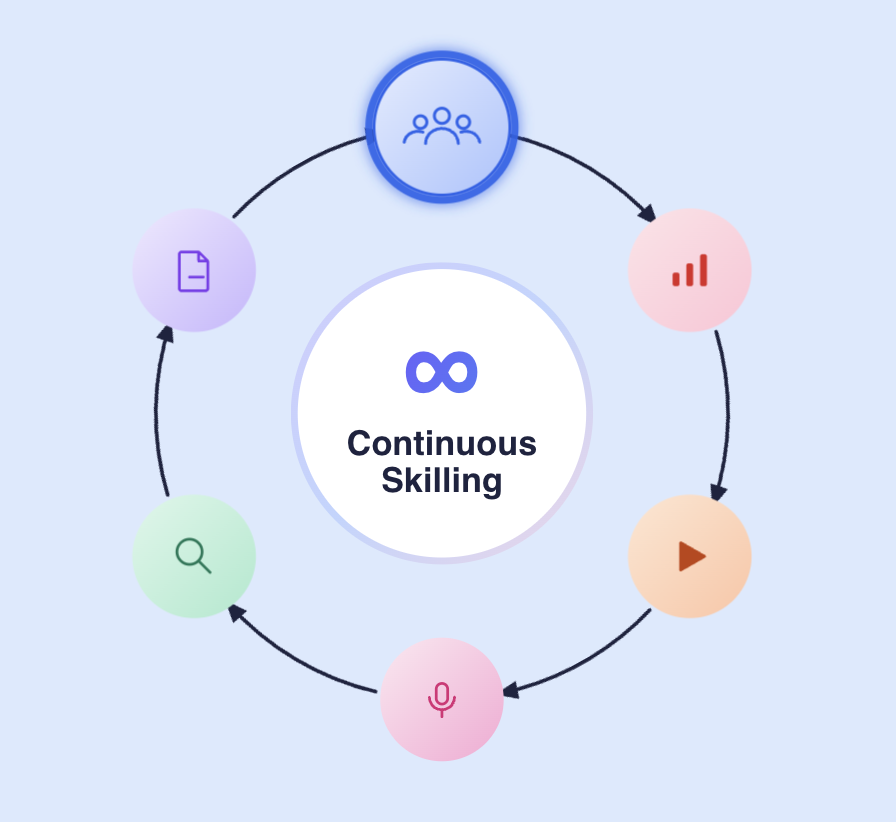
It works as a loop: find the gap, close it, check that it closed, and repeat. That's what turns one-off training into continuous skilling.
Why Capability Evidence Matters
Competence beats completion.
A training record tells you someone finished a course. It doesn't tell you they can do the job, on your machine, to your standard.
It's like judging a cook by whether they've read the recipe. You only find out the truth when dinner hits the table. In a plant, that moment is a failed audit, a scrapped batch, or a line stoppage.
Strong capability evidence shares a few traits:
- Tied to the machine. It shows who can do a task on a specific machine, line, or site, not just who holds a job title.
- Measured in levels. Proficiency moves from "read the SOP" to "assessed" to "observed" on the job, so you can see how far each person has really gotten.
- Traceable to an approved source. Every training sentence links back to a procedure or expert recording that a qualified person signed off.
- Linked to plant KPIs. It sits next to non-conformances, scrap, downtime, and first-pass yield, so you can see whether better skills changed results.
There's one more distinction that saves a lot of wasted training: the difference between a skill gap and a knowledge gap.
A skill gap means a person or team is below the required standard. A knowledge gap means the approved material to teach that skill doesn't exist yet.
Why does that matter? Because retraining people on a procedure nobody ever wrote down won't fix anything. You have to capture the missing work first.
Here's how that shift looks side by side:
| Traditional approach | Workforce intelligence | |
|---|---|---|
| Workforce visibility | Completion data | Capability and competency evidence |
| Expert knowledge | Passed on through shadowing | Captured, reviewed, and reusable |
| Accuracy | Dependent on the author | Checked and traceable to source |
| Measurement | Course completion | Reassessment plus operational evidence |
| Learning cycle | One-off intervention | Continuous skilling |
Can You Trust AI-Powered Workforce Intelligence in a Regulated Plant?
AI is what makes workforce intelligence practical at plant scale. It can read thousands of procedures, match them to skills, and draft training in minutes instead of months.
But speed means nothing in a regulated plant if the output is wrong.
Trust comes down to data. In a Salesforce survey of nearly 6,000 knowledge workers, 82% said accurate data is critical to trusting AI, and 82% said the same about secure data. Among workers who don't trust the data behind AI, 68% said they're hesitant to adopt it.
Operators, quality managers, and auditors are no different. If they can't see where an answer came from, they won't rely on it. And they shouldn't.
That's why my team built Edplay around one rule: AI writes. Edplay checks. You decide.
Here's what that means in practice:
- Grounded in your knowledge. Training starts with your approved policies, procedures, documents, and expert knowledge, not generic content from the internet.
- Checked and traceable. Edplay checks information against the sources and standards that apply. Every sentence in a course traces back to an approved source, so auditors and safety reviewers can see the evidence.
- Approved by your people. A qualified reviewer checks the evidence and applies their judgment before anything becomes approved knowledge or training.
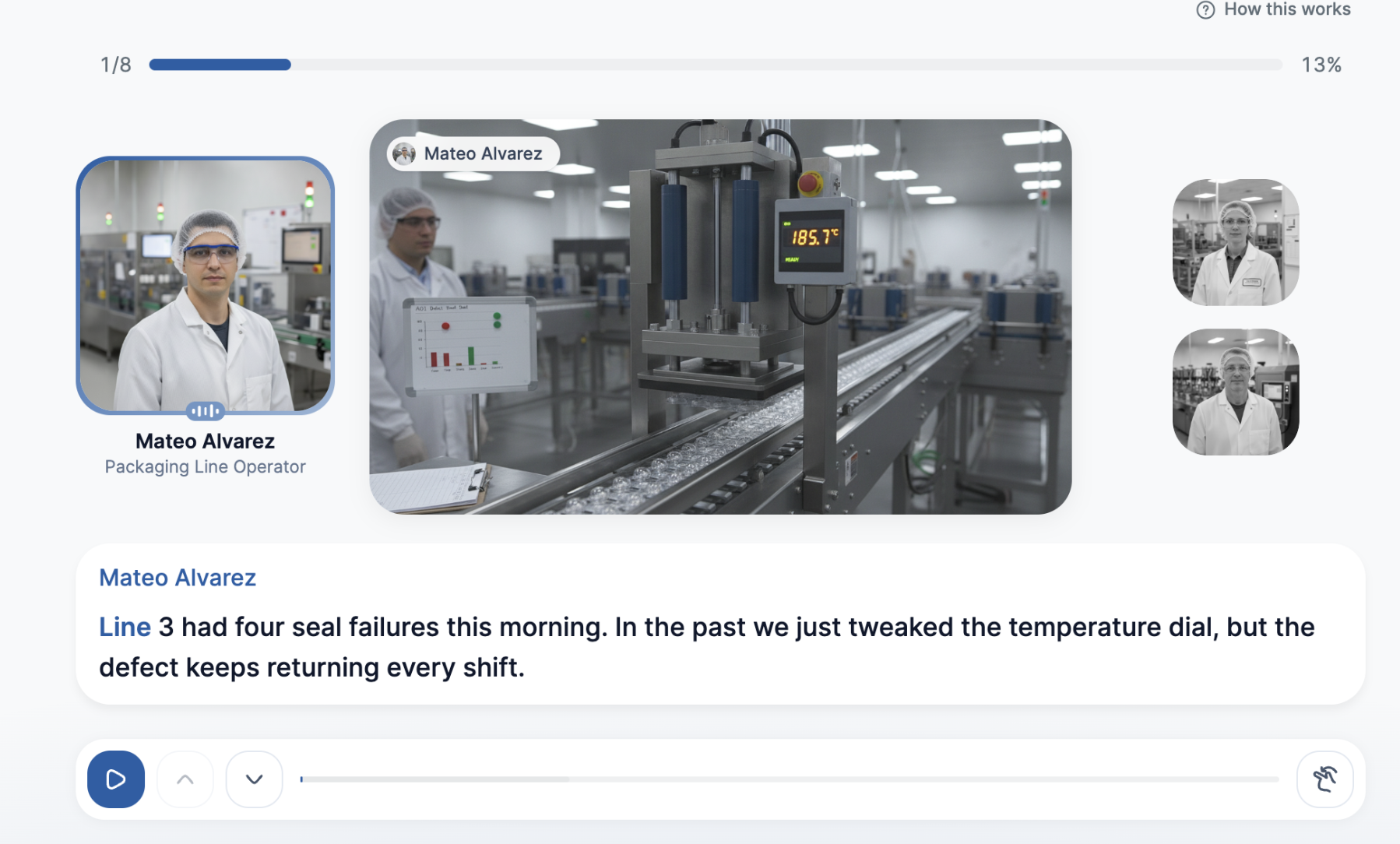
Data security matters just as much. Your SOPs, machine setups, and floor recordings are never used to train AI models. You also choose where your data lives: on-premise, in your own cloud tenant, or in Edplay's isolated cloud environment.
Edplay also meets the ISO 27001, ISO 42001, and SOC 2 security standards. ISO 42001 is the international standard for managing AI systems, which matters when AI helps shape what your people are trained on.
For AI-powered workforce intelligence, trust isn't a bonus feature. It's the whole point. Learn more about how this works in our guide to AI-generated training in regulated industries.
How to Measure Workforce Capability
Measuring workforce capability is just as important as building it. If you can't show the gap closed, you can't show the training worked.
A workforce intelligence platform like Edplay lets you:
- See proficiency per machine and line, across shifts and sites.
- Spot missing coverage and single points of failure before they stop a line.
- Find where a skill is missing and where the knowledge needed to close it is missing too.
- Track recurring support needs, so you know which tasks keep tripping people up.
The skills picture is only half of it. You also need to know whether better skills changed results on the line.
Here's how to do it:
- Lock a baseline first. Before anyone is trained, record the measures that matter on that line: non-conformances, scrap, downtime, first-pass yield, or time to competence for new starters.
- Reassess people after training. Use assessments, scenario decisions, practical checks, and supervisor sign-off, not just a quiz score.
- Compare against the baseline. Look at the same measures, on the same lines, after training.
- Repeat until the gap closes. Reassess workers until each gap is verifiably closed.
One caution: skills and line results improving together is a strong signal, but not proof on its own. Machines, materials, and staffing change too. Agree up front on what counts as success, so nobody argues about the numbers later.
As you add lines and sites, tracking this in spreadsheets takes too much time. The right platform keeps capability and KPIs in one place, so you catch problems early and make smarter training decisions.
Workforce Intelligence Best Practices
You're ready to start, but you can't connect every system at every site on day one. Here's where to focus first:
Start with one or two critical lines. Pick the lines where downtime, scrap, or single points of failure hurt the most. A focused start gives you clear results to show leadership before you scale.
Capture knowledge before the retirement party. Find the tasks only one or two people know how to do. Then capture how the work is really done, from the people who do it best, and have it reviewed and approved before use. Learn how in our guide to capturing tribal knowledge.
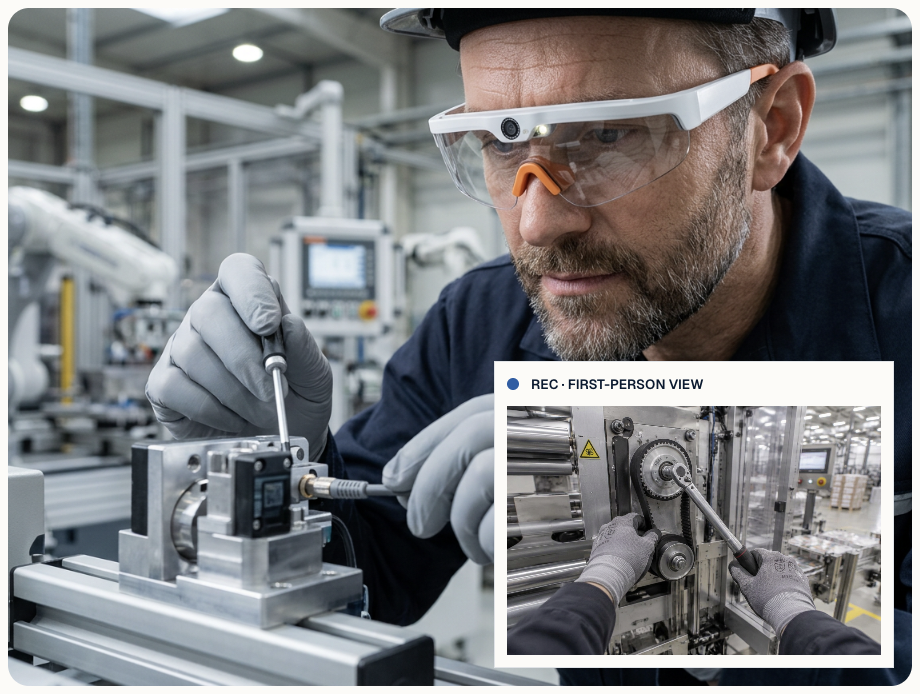
Fix knowledge gaps before you retrain people. If the approved material doesn't exist, more training won't help. Capture the missing work first, then build training from it.
Keep a human approving every step. AI prepares, people decide. Nothing should become approved knowledge or training until a qualified reviewer signs off.
Agree on success measures before you start. Decide what "better" means for each line, and lock the baseline. Then hold a clear go/no-go decision at the end.
That's how a 12-week pilot with Edplay works. It runs on one or two production lines, in three phases:
- Weeks 1–4: Connect, match, and baseline. Check sources, map required skills, find skill and knowledge gaps, and set the operational baseline.
- Weeks 5–8: Capture and verify. Invite operators and technicians to share knowledge, record selected tasks, and review and approve the evidence.
- Weeks 9–12: Create and prove. Build targeted training from approved evidence, assess capability, and compare operational results with the baseline.
At week 12, you answer three questions. Did we find gaps we can act on? Did we turn missing knowledge into approved training? Did capability improve alongside operational performance?
Workforce intelligence rewards consistency. Check out our full guide to knowledge transfer in manufacturing for a deeper look at execution.
FAQs
What is workforce intelligence?
Workforce intelligence is the practice of connecting people and competency data, process knowledge, and operational signals to see where skill and knowledge gaps are costing you. In manufacturing, it shows who can do which task on which machine, and whether training actually improved results on the line. It matters more as experienced workers retire: up to 1.9 million US manufacturing jobs could go unfilled by 2033, according to Deloitte and The Manufacturing Institute.
How is workforce intelligence different from people analytics?
People analytics uses HR data to guide hiring, retention, and career decisions. Workforce intelligence in manufacturing goes further by linking that data to your procedures and to plant KPIs like scrap, downtime, and first-pass yield. The goal is proven capability on the line, not just better HR reporting.
How do manufacturers get started with workforce intelligence?
Start with one or two critical lines where downtime, scrap, or single points of failure hurt the most. Agree on success measures, lock a baseline, capture any missing knowledge, and reassess people after training. A 12-week pilot with a go/no-go decision at the end is a low-risk way to prove the value before you scale.
Conclusion
Workforce intelligence is one of the most important tools a manufacturer can have right now. It connects who your people are, what your procedures say, and how your lines perform, so you can see skill gaps before they turn into scrap, downtime, or safety incidents.
The work is ongoing. You need to find the gaps that cost the most, capture knowledge before it retires, build training from approved sources, and prove the gap closed. Then do it again as machines, procedures, and people change.
Start with the lines most likely to move the needle fastest. Keep it focused. Keep it measured. For a deeper look at the problem, read our guide to the manufacturing skills gap.
Want to see what workforce intelligence can do on your own lines? Plan your 12-week pilot with my team.
About the Author

Thomas Bellamy
Co-founder & CRO, Edplay
Thomas Bellamy is Co-founder and CRO at Edplay, where he leads global revenue operations and sales strategy. A revenue leader and EdTech strategist, he has helped build learning technology businesses from inception to acquisition. Thomas and Victor Potapov started My Learning Hub in London in 2014. As its former Head of Sales, Thomas built the sales engine that supported the company’s growth and successful acquisition. That experience informs Edplay’s work connecting workforce skills with the knowledge already inside an organization.
LinkedIn